
Play is the way.
Founders and innovators don't learn much sitting still. So we coach them standing up — building, drumming, arguing, pitching a plastic butterfly to the room. Play is the method, not the warm-up, and the community it makes is stickier than apple sauce.
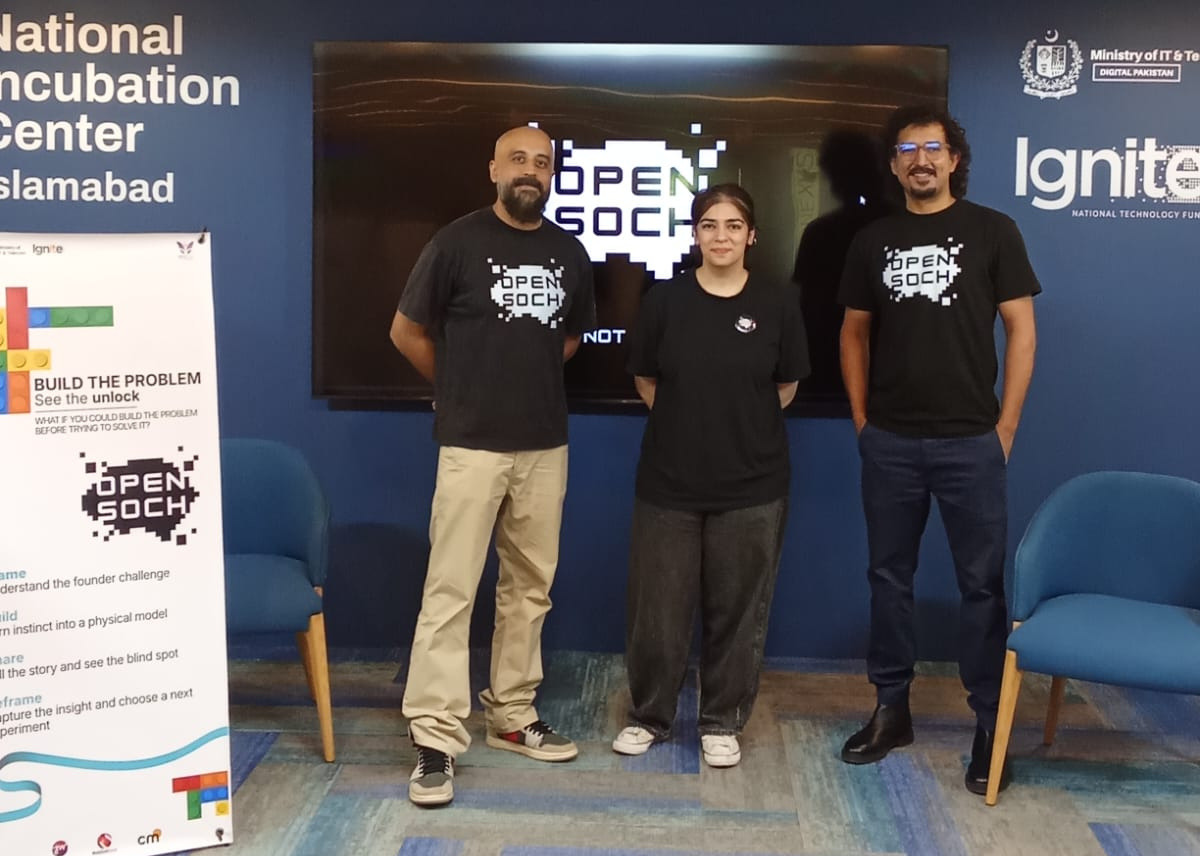
It started with eight LEGO bricks and a room that wouldn't speak.
The first version was an experiment at someone else's event: hand every founder the same eight pieces, give them sixty seconds to build a butterfly, and see what a room does when the instruction is absurd enough that nobody can perform expertise.
It worked in the way physical things work. People stood up. People laughed at their own butterfly. Then they talked to each other for an hour without being told to network.
Every format since — the circles, the drums, the deep dives, the open hour — came from the same question: what has to happen physically to turn a group of random innovators into a genuine community?
A band that keeps re-forming.
Shez and Rish met in 2011 on opposite sides of the table — Rish was heading digital at Creative Chaos, Shez doing strategy and insights at Unilever Pakistan. They went their own ways: Shez to Singapore and a decade at Unilever, then HP; Rish to his own agency in Pakistan.
In 2017 they built Jambro, a way for musicians to find each other. It reached a community across 500 cities and epic jams from the ports of Karachi to Hard Rock Cafe, Singapore. Then Covid stopped live music everywhere at once, and they exited reluctantly.
OpenSoch is the same instinct, pointed at founders and innovators instead of musicians: put people in a room and give them something to do together.
Four things we keep proving to ourselves.
The people who run the room.
Three of us run the sessions — plus a wider bench of facilitators, coaches and musicians we bring in by format.

How to build a community where innovation can actually thrive?
We've been the founders in the room. We know what's missing from it.